
Overview
Our 7 Day Morocco Tour from Fes is the perfect way to see the real heart of this country. Starting right from one of the most fascinating cities in the world, you travel south through the Middle Atlas Mountains, deep into the Sahara Desert, and then across the stunning southern valleys before climbing the High Atlas and arriving in Marrakech.
Seven days is enough time to do it properly without rushing and without missing anything important. You get to sleep in the Sahara under the stars, ride camels into the dunes at sunset, walk through ancient kasbahs, stand inside towering canyon walls, and drive over the highest mountain pass in Morocco. Every single day feels different.
This is a fully private tour, which means the vehicle, the driver, and the entire schedule belong to you. If you want to stop somewhere for longer, you stop. If you want to start early and beat the crowds, you start early. There are no strangers in the car and no waiting around for other people. Just your group, an expert driver-guide, and one of the best road trips in Africa.
The tour ends in Marrakech, which is much more convenient than going back to Fes and it means you get to explore the souks and the Djemaa el-Fna square on your own after the tour finishes.
Tour Highlights
- Sleep in a Berber desert camp inside the Erg Chebbi dunes of Merzouga
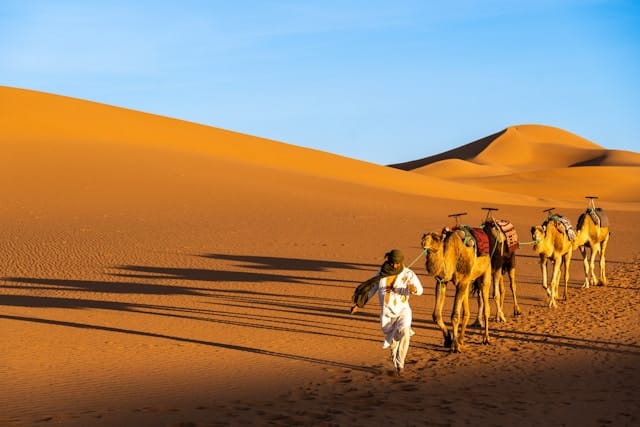
- Camel trek at sunset into the Sahara dunes one of Morocco’s most magical moments
- Walk through Ait Ben Haddou, the UNESCO mud-brick kasbah of Game of Thrones fame
- Cross the High Atlas Mountains via the spectacular Tizi n’Tichka mountain pass
- Stand inside Todra Gorge a narrow canyon with 300-meter sheer rock walls on both sides
- Drive through the Valley of Roses and the dramatic Dades rock formations
- Explore the Draa Valley and its endless palm groves following the oldest caravan route in Morocco
- Wake up to the Sahara sunrise from the top of a sand dune with no city lights for hundreds of kilometers
- See Berber musicians play around a campfire under the stars far from any town or road
- Watch wild Barbary macaque monkeys in the cedar forests near Azrou
- Arrive in Marrakech and explore the Djemaa el-Fna square on your own terms
- Drive through the Ziz Valley palm groves thousands of date palms in a narrow desert gorge
Full 7 Day Itinerary: Morocco Tour from Fes
Day 1 : Fes – Azrou – Ifrane – Ziz Valley – Er Rachidia
The first stop is Ifrane a small mountain town that looks completely out of place in Morocco. Red-roofed chalets, manicured parks, clean wide streets. It was built by the French in the 1930s and is now home to one of Morocco’s top universities. It is nothing like the rest of the country, and that is exactly what makes it interesting. Worth a short stop and a walk around.
From Ifrane, you continue to Azrou a small Berber market town in the heart of the cedar forest. The forest here is ancient and dense, and the main reason to stop is the Barbary macaque monkeys. These wild monkeys live freely among the cedar trees and regularly come down to the roadside looking for food. Children absolutely love this stop, and honestly, most adults do too. You can get very close to them. Bring some fruit if you can.
After Azrou, the road drops south through Midelt a good lunch stop with simple local restaurants and views of the High Atlas range to the south. Then the landscape shifts dramatically as you enter the Ziz Valley. Thousands of date palms follow the river through a long narrow gorge, and the contrast of deep green against the orange-brown rock walls is one of the most striking views of the whole trip. The road winds along the edge of the gorge, and you will want to stop and take photos more than once.
You arrive in the Er Rachidia area in the evening. Dinner and rest. Tomorrow, the Sahara Desert.
Day 2 : Er Rachidia – Erfoud – Rissani – Merzouga – Sahara Camel Trek – Desert Camp
Today you reach the Sahara Desert. After a good breakfast, you head south toward the dunes.
On the way, the first stop is Erfoud a desert town famous for its fossils. The rocks in this region are packed with 300-million-year-old sea creatures from when the whole Sahara was underwater. At a local fossil workshop you can watch craftsmen chip and polish the dark limestone to reveal ammonites, trilobites, and fish skeletons perfectly preserved inside. It is a genuinely surprising thing to see, and you can buy small pieces as souvenirs.
Then through Rissani, one of the oldest and most authentic market towns in southern Morocco. This was once a major stop on the trans-Sahara caravan route, and the weekly market still draws Berber traders from across the region. Dates in every variety, spices, livestock, handwoven goods. No tourist stalls here just real local life in a town that has been doing the same thing for centuries.
“And then you see them. The dunes appear from nowhere rising out of flat desert floor, golden and enormous. The first time you see Erg Chebbi, you stop talking. You just look.”
The Erg Chebbi dunes near Merzouga rise up to 150 meters high and stretch for kilometers in every direction. They are among the most dramatic sand dunes in all of Africa. After freshening up at your guesthouse, your camel guide is waiting at the edge of the dunes.
The camel ride takes you slowly into the desert as the sun drops. The sky turns from blue to orange to deep red. The sand shifts colors with it. The silence out here is complete — no traffic, no machines, no noise of any kind. Just the soft padding of camel feet on sand and the vast empty sky above you. It sounds like a cliché until you are actually in it. Then it just feels perfect.
At the traditional Berber camp, dinner is served around a fire. A Berber musician plays guembri and drum. The conversation flows and then, when you look up, the Milky Way is so bright and clear that it stops people mid-sentence. Most guests stay outside for a long time, just watching the stars. There are no city lights within hundreds of kilometers.
Day 3 : Sahara Sunrise – Merzouga – Todra Gorge – Dades Valley
Set your alarm before sunrise. It is one hundred percent worth it.
Your guide takes you to the top of a nearby dune while it is still dark. You sit in the quiet and wait. The horizon starts to lighten slowly dark purple, then orange, then deep gold. The shadows on the dunes change every few minutes as the sun climbs. The whole desert slowly comes to life around you. There is no better way to start a day anywhere in the world.
After the sunrise and breakfast back at camp, you say goodbye to the desert and start heading west. The road crosses flat stony hammada the rocky desert plateau that stretches between the dune fields and then climbs through dry river valleys toward the mountains.
Todra Gorge is one of those places that genuinely surprises people. You drive along the Todra River and then, suddenly, the canyon walls close in on both sides. Within a few hundred meters, the walls rise 300 meters straight up sheer orange and pink rock on both sides, with a narrow strip of blue sky far above. The gorge floor is only about ten meters wide at its narrowest point. You walk through it and feel very small in a very good way.
Local cafes sit right inside the gorge and serve mint tea and simple food at tables right next to the river. If you want to cool off, the shallow river water is cold and refreshing, straight from the mountains above.
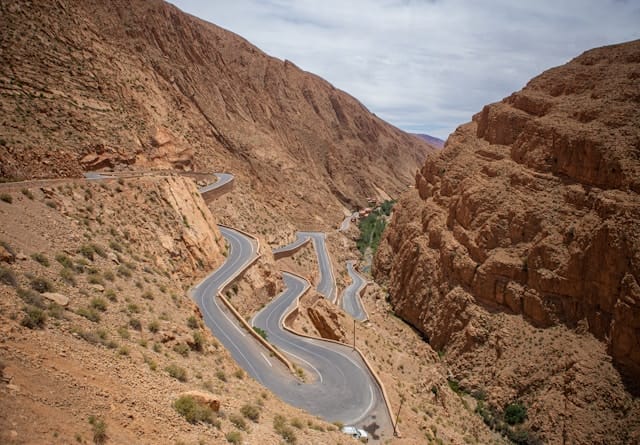
After the gorge, you drive west through the Dades Valley also called the Valley of Roses for the thousands of rosa damascena plants that bloom here every April and May. The valley is beautiful year-round, with red rock formations, green orchards, and ancient mud-brick villages built along the river. The famous Dades Gorge rock formations twisted, layered columns of rock known locally as the “monkey feet” are worth a short stop for photos.
You arrive at your accommodation in the valley in the late afternoon. Time to rest, watch the sunset over the red cliffs, and sleep well.
Day 4 : Dades Valley – Draa Valley – Agdz – Ouarzazate
Today is one of the most scenic driving days of the entire trip. You leave the Dades Valley and head southwest through the Draa Valley the longest river valley in Morocco, following the Draa River from the mountains toward the Sahara edge.
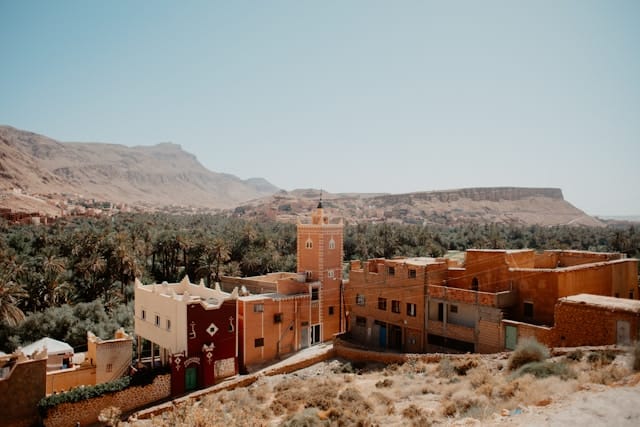
The Draa Valley has been a major trade and migration route for thousands of years. The road passes through endless palm groves literally millions of date palms following the riverbed and through a string of old Berber villages with mud-brick kasbahs and fortified grain stores called agadirs. Many of these are centuries old and still in use.
The town of Agdz sits at the northern end of the valley and is a perfect lunch stop. The market here is lively and authentic, and the old kasbah on the hill above town is worth a short climb for the view over the palm sea below.
By mid-afternoon you arrive in Ouarzazate the so-called Hollywood of Africa. The city has been the filming location for hundreds of major productions including Lawrence of Arabia, Gladiator, Kingdom of Heaven, The Mummy, and more recently Game of Thrones and Babel. Film studios are open to visitors if you are curious, but the real star of Ouarzazate is nearby and you will see it properly tomorrow morning.
Ouarzazate is a comfortable and pleasant town to spend the evening. Good restaurants, a lively centre, and the best rosewater ice cream in Morocco (no exaggeration try it).
Day 5 : Ouarzazate – Ait Ben Haddou – Skoura – High Atlas Mountains – Marrakech
The morning starts with one of the most iconic stops in all of Morocco: Ait Ben Haddou.
This ancient UNESCO World Heritage ksar sits on a hillside above the Ounila River and is one of the best-preserved examples of earthen architecture in the world. The entire city towers, walls, houses, granaries is built from mud bricks mixed with straw and palm wood. It has been continuously inhabited for over a thousand years, and some families still live inside.
You will recognise it immediately. Game of Thrones filmed here (it was the city of Yunkai). So did Gladiator, The Mummy, Babel, Jewel of the Nile, and dozens of other films. The location is extraordinary crossing the shallow river and climbing up through the narrow streets to the top gives you views over the surrounding desert valley that are genuinely breathtaking.
Allow at least 90 minutes here. It is one of those places where you keep finding new corners and new viewpoints every time you turn around.
After Ait Ben Haddou, you drive through the small oasis village of Skoura with its famous palm grove, and then the road starts to climb into the High Atlas Mountains.
The Tizi n’Tichka mountain pass reaches 2,260 meters above sea level the highest paved road in all of Africa. The views on the way up and over are staggering. Steep valleys, tiny Berber villages clinging to the cliffs, argan trees, and layer after layer of mountain ranges stretching to the horizon. In winter the pass can have snow. In summer the air is cool and fresh and the colours of the rock are extraordinary red, green, purple, orange.
By late afternoon, the road drops down the north side of the mountains and the city of Marrakech appears in the valley below. After days in the quiet desert and mountains, arriving back in a city feels almost overwhelming but in the best possible way.
Day 6 : Free Day in Marrakech — The Red City
“Most tours rush through Marrakech. We give you a full free day. Explore at your own pace. You will be glad we did.”
Today is completely yours. No driving, no schedule, no rushing from one place to another. Just you and one of the great cities of the world.
Start with the Djemaa el-Fna square the famous main square of Marrakech that is different every hour of the day. In the morning it is relatively quiet with juice stalls and a few snake charmers. By noon the food stalls start setting up. By evening it is one of the most extraordinary spectacles in Africa: hundreds of vendors, storytellers, musicians, dancers, acrobats, henna artists, and spice sellers, all going at full volume at once.
The Marrakech medina souks spread north from the square in a labyrinth of lanes organized roughly by trade: leather workers, copper smiths, wood carvers, weavers, spice merchants, lantern makers. It is easy to get lost (in a good way) and easy to find your way back by following the sound of the square. Take your time, explore without pressure, and drink mint tea with the shopkeepers they are usually great company.
Other highlights worth your time: the Bahia Palace, a stunning 19th-century riad palace with painted ceilings and mosaic courtyards. The Saadian Tombs, a beautifully decorated royal mausoleum. The Koutoubia Mosque and its elegant minaret that has inspired mosque architecture across the Mediterranean. Or simply find a rooftop café above the medina, order a pot of tea, and watch the whole city move below you.
In the evening, have dinner in the square itself the open-air food stalls serve everything from snails to lamb chops to fried fish, and the atmosphere is completely unlike anywhere else on earth.
Day 7 : Marrakech — Tour Ends
Your tour officially ends today in Marrakech. Breakfast at your hotel, and then you are free.
If you have an early flight, your driver can take you to Marrakech Menara Airport — it is only about 15 minutes from the medina. If your flight is later, you have the whole morning to walk through the souks one more time, visit the Majorelle Garden (Yves Saint Laurent’s famous garden, now a museum book in advance), or simply sit in a café with a coffee and let the city wash over you for a few more hours before you leave.
Seven days, two mountain ranges, one Sahara, three valleys, a UNESCO kasbah, a desert camp under the Milky Way, and a full free day in one of Africa’s great cities. You will go home with a full camera card and a very good answer when people ask what your trip was like.
What’s Included and Not Included:
Included
- Private air-conditioned vehicle with experienced driver-guide
- 6 nights accommodation (riads, guesthouses, desert camp)
- Camel trek into the Erg Chebbi dunes at sunset
- 1 night in traditional Berber desert camp with dinner
- Daily breakfast at each accommodation
- All fuel, road tolls, and parking fees
- Hotel pickups and drop-off at Marrakech airport or hotel
Not Included
- International flights to/from Morocco
- Lunches and dinners (except desert camp dinner)
- Entry fees to sites (Ait Ben Haddou, Bahia Palace, etc.)
- Guide fees in Marrakech medina (optional, available locally)
- Travel insurance (strongly recommended)
- Tips for driver, guide, and camp staff (appreciated)
- Personal expenses and souvenirs
Why Choose This Tour
This 7 day desert tour from Fes to Merzouga is a perfect choice for people who want to see the best of Morocco in a simple and comfortable way. It gives you enough time to enjoy every place, not only the desert but also the mountains, valleys, kasbahs, and local culture. It is ideal for couples, families, friends, and anyone looking for a real desert experience.
Gallery: 7 Day Morocco Tour from Fes
FAQ – 7 Day Desert Tour from Fes to Merzouga
Is this tour suitable for first-time visitors to Morocco?
What is the best time of year to do the 7 Day Morocco Tour from Fes?
The best months are March to May and September to November. Spring is especially beautiful — the Valley of Roses is in bloom, the Atlas Mountains are green, and the desert temperatures are comfortable. Summer (June–August) is very hot in the Sahara, with temperatures sometimes reaching 45°C. Winter can be cold in the mountains but the desert is mild and usually crowd-free.